Exclusive: Makera Just Closed the Biggest Round Consumer-Grade CNC Has Ever Seen
Hundreds of millions of yuan, co-led by Huaying Capital and Beijing's AI Industry Fund — and the entire deal is a bet that the next Bambu Lab is in subtractive manufacturing.

Originally published in Chinese by PEdaily AI (投资界AI). Translated by ChinaUnread.
Author | Wu Qiong
TLDR | AI Summary by ChinaUnread
Makera (造物时代), a Beijing consumer-grade CNC startup, just closed a Series A of “hundreds of millions of yuan” — the largest single round ever raised in consumer-grade CNC. Co-led by Huaying Capital and the Beijing AI Industry Investment Fund, with Oriza Puhua, Zhongke Sirius Capital, and Zero2IPO Capital following on, and existing investor Qiming Venture Partners staying in with a super-pro-rata. The round was oversubscribed by several multiples of the original target.
Founder Zhang Qiuxi (CS, Beihang University) hand-built his first CNC in 2014 because nothing on the market fit his RC-plane and drone hobby. He listed it on Taobao, sold a few hundred units in year one, and incorporated Makera in 2019 to take industrial-grade machining onto a regular desktop.
Q4 2025 turning point: the Makera Z1 raised $10.25M from ~8,000 paying users on overseas crowdfunding — a global crowdfunding record for the CNC category. More than 90% of buyers were pure consumers, not industrial users.
The investor thesis is explicit: Makera is the CNC version of Bambu Lab — the consumer 3D-printing company that shipped 1.2M units in 2024 (35.5% market share) and crossed ¥10B (~$1.4B) in revenue in 2025. Makera’s full-year 2025 revenue grew 4x+; Q1 2026 was up nearly 3x YoY before the entry-level Z1 had even gone on sale at scale; top Chinese investment banks are already in early IPO conversations.
PEdaily has learned that today (May 6), Makera (造物时代), the global leader in consumer-grade CNC, officially announced it has closed a Series A funding round of hundreds of millions of yuan. The round was co-led by Huaying Capital and the Beijing AI Industry Investment Fund, with Oriza Puhua, Zhongke Sirius Capital, and Zero2IPO Capital as follow-on investors; existing investor Qiming Venture Partners also stayed in with a super-pro-rata follow-on.
This is the largest single funding round ever raised in consumer-grade CNC. One detail PEdaily picked up: even during the prep phase, Makera had already been oversubscribed several times the original target.
Just as consumer-grade 3D printing took off over the last few years, consumer-grade CNC is now walking into VC’s mainstream view. The next Bambu Lab may already be taking shape.
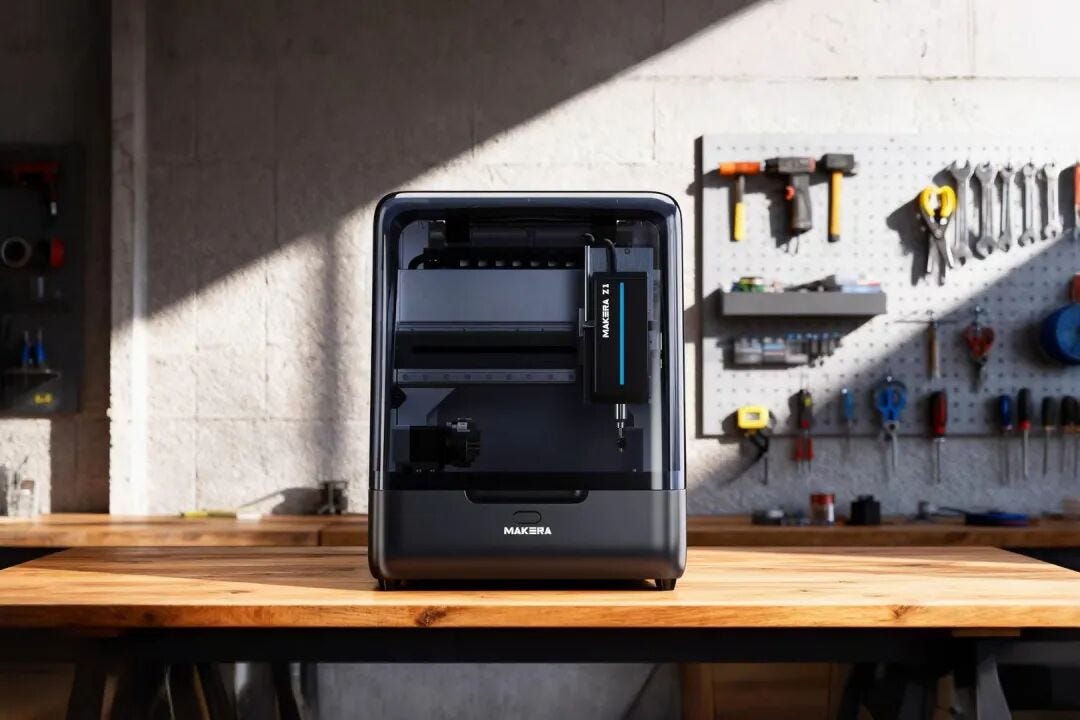
From a Beihang Maker to a Desktop Micro-Factory
Makera’s story starts with a serious geek.
Founder Zhang Qiuxi is a CS grad from Beihang University (Beijing University of Aeronautics and Astronautics), with more than a decade of hardware-and-software R&D experience and a long history as a maker. In 2014, he got into RC planes and drones — and needed a CNC to machine the carbon-fiber frames and aluminum parts. Nothing on the market actually fit personal use, so he built one himself. To his surprise, when he listed it on Taobao, he sold a few hundred units in the first year. That was Makera’s original user base.
For readers outside the maker world: CNC stands for Computer Numerical Control — software-driven precision cutting, engraving, and milling. Where 3D printing is additive (stacking plastic or resin layer by layer), CNC is subtractive: it precisely removes material from a solid block. That subtractive capability is exactly why CNC can produce the kind of high-strength, high-precision, real-feeling finished parts that 3D printing can’t.
By 2019, a handful of small-form-factor CNC products had appeared on the market — but most were “functional but not actually usable.” Spotting the opening, Zhang gathered friends from the RC and maker scenes and founded Makera.
From day one, Makera has been focused on a single goal: take industrial-grade machining and put it on a regular desktop. CNC has long been locked inside factory workshops — too bulky, too complex to operate, too sensitive to its environment to live anywhere else. The few desktop-class machines that did exist were essentially “half-finished” — they assumed the user already had a serious engineering background and was willing to assemble the rest. Makera was the company that broke that deadlock.
“We’re not making a smaller CNC,” Zhang explains. “We’re redefining the boundaries of personal manufacturing.” With deep robotics expertise on the core team, Makera tightly integrated industrial-grade motion control, an automatic tool-changer, and dust-proof and noise-suppression systems into what is genuinely a “desktop micro-factory” — built for the global community of makers, designers, and DIY enthusiasts hungry for high-precision metal and multi-material machining.
The turning point came last year. In Q4 2025, the Makera Z1 raised $10.2451 million on overseas crowdfunding from nearly 8,000 paying users worldwide — a global crowdfunding record for the CNC category. The detail that matters: more than 90% of Z1 buyers were pure C-end consumers, not industrial users.
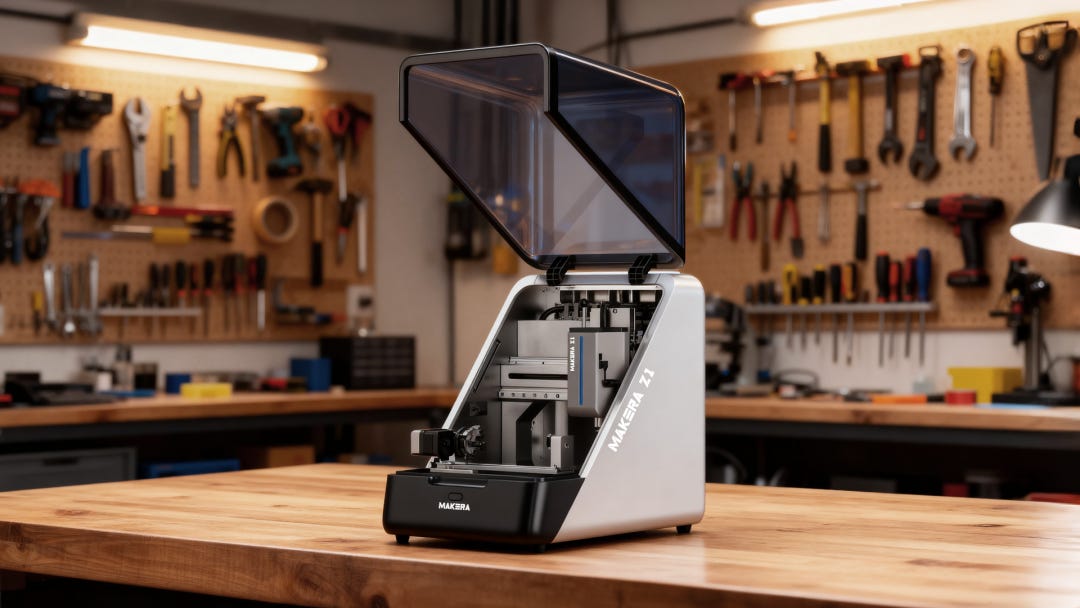
That tells you something: CNC is finally crossing out of the geek tier into the much broader markets of home workshops, art education, and personalized custom manufacturing.
Hardware alone wasn’t going to be enough — software and content were just as critical. Since 2021, Makera has been building its own CAM (computer-aided manufacturing) system in-house, with dozens of mature, stable toolpath algorithms that have collapsed the learning curve. The company is also building out a global maker content community where users aren’t isolated tool-owners but participants in a shared ecosystem — trading machining parameters, CAD files, and project ideas.
That gives Makera a closed-loop “hardware + software + content” stack — a moat competitors can’t replicate overnight. The oversubscription on this round leaves the company with plenty of ammunition; the capital will go primarily toward the next generation of products and toward deeper investment in the brand and ecosystem.
Hunting for the Next Bambu Lab
Look around: Chinese hardware brands are quietly taking over the global maker scene.
Inside the maker world, 3D printers, laser engravers, and CNC machines are known as the “maker’s three pieces” — the trio that countless DIY hobbyists are addicted to.
Of the three, consumer-grade 3D printing exploded first — and the company out front was Bambu Lab. In 2020, Tao Ye, who had spent eight years at DJI running its consumer-drone product line, decided to leave and start his own company; he co-founded Bambu Lab Technology with several former colleagues.
What nobody saw coming was that within a few years Bambu Lab single-handedly pulled the entire consumer-grade 3D printing market up with it. In 2024, Bambu shipped 1.2 million units and grabbed 35.5% market share — the year’s #1. In 2025, revenue crossed ¥10 billion (~$1.4 billion).
The bittersweet detail: in Bambu’s early years, almost no one was paying attention. The handful of investors who got in were IDG Capital, 5Y Capital, Mingshi Investment, and Danming Capital. Today, Bambu Lab is closed — there’s no more room. So a new refrain has been spreading through China’s VC circles: “find the next Bambu Lab.”
And in many ways, Makera is being read as “the Bambu Lab of CNC.” The parallels are real: both used crowdfunding to validate demand, both leaned heavily into automation and ease of use, and both bind users in through a software ecosystem. Before this Series A, Makera had already raised a Pre-A led by Qiming Venture Partners.
The other parallel is that both went global from day one. Makera was built as a global-facing tech brand from the moment it was founded, targeting the mature DIY and maker markets in North America, Europe, and Asia-Pacific. Its products are now in dozens of countries and have moved well beyond personal studios — into research labs at Harvard, MIT, and Stanford, as well as the prototyping departments of top-tier tech companies including Apple, GM, and Volkswagen.
The breakout moment is arriving. PEdaily has the numbers: full-year 2025 revenue grew more than 4x.
And 2026 is accelerating from there. Q1 2026 was up nearly 3x year-on-year — and that’s before the entry-level Makera Z1 had even officially gone on sale at scale. The growth came from the existing product line continuing to penetrate.
“Can’t miss the next Bambu Lab” — that’s the line, and the investors have piled in. Several top-tier Chinese investment banks have already approached Makera in recent weeks to start preliminary IPO conversations.
“Makera’s vision is that every individual should have the ability to create real, physical products,” Zhang summarizes. When the tool stops being a barrier, creativity gets fully unleashed — and the imagination space, he argues, is only just beginning to open up.
(Cover image and article images courtesy of Makera.)